
Founder & Designer · Building
What if a story didn't end when the book closed?
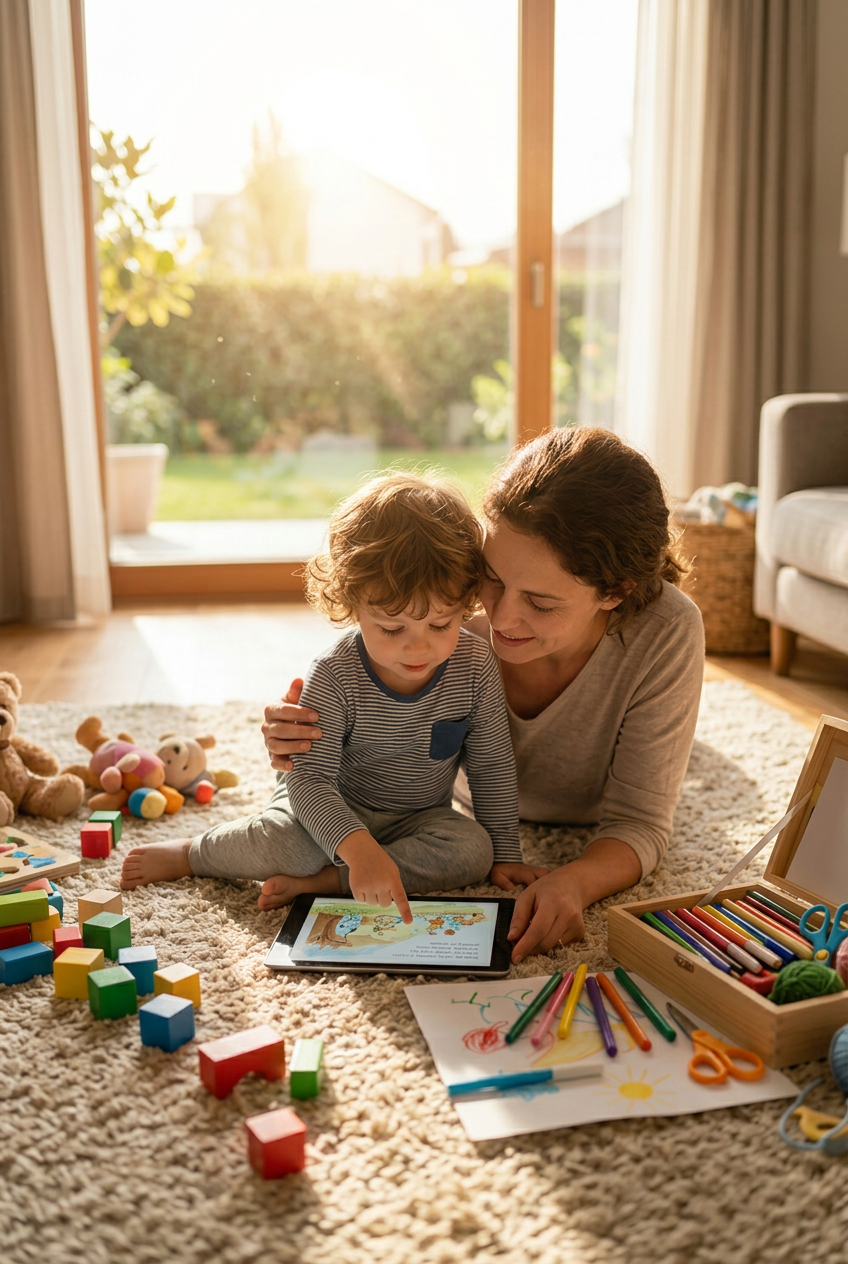
Myli is a personalised interactive storytelling experience designed for parents and children to create, explore, and extend stories together — beyond the screen.
UX Research
Product Strategy
Interaction Design
Solo · End-to-end
<60s
Onboarding target for parents
5+ min
Child engagement benchmark
4
Competitors analysed
Why this project exists
This isn't a brief. It's a memory.
Myli didn't start with a gap in the market. It started with five nephews&nieces, two years reading with children in Dublin as an au pair, a couple of years teaching art in Brazil, and a children's book I wrote and illustrated myself. I didn't research this problem from the outside: I lived it, across two countries, multiple ages, from both sides of the page.
| 5 | 2 yrs | 1 | 5+ |
|---|---|---|---|
| Nephews aged 4, 7, 9, 9 and 11, nearly the full target range | Au pair & babysitter in Dublin, running reading sessions with real children | Children's book self-written and illustrated, I know what holds attention on a page | Years in art & design teaching, iterating on children's engagement in classrooms |
Moment of magic
When they became the character
My niece asked me to read the story again with her own name replacing the hero's. She sat completely still for 40 minutes. The story hadn't changed, but her role in it had.
Moment of disengagement
When the page asked nothing of them
Every child I cared for in Dublin lost interest at exactly the same point: when they stopped being able to do anything. Passivity was the problem, not the content.
Moment of surprise
When the story followed them to breakfast
The best evenings weren't when the book was best. They were when the story became something we kept drawing and inventing the next day. The screen had switched off. The story hadn't ended.
THE PROBLEM"Parents and children love shared reading, but digital books often feel commercialised, flat, or impersonal. How might we create an interactive storytelling experience that blends imagination, creativity, and family bonding, and extends beyond the screen?"
| Before research: what I assumed | After research: what I found |
|---|---|
| Children don't like reading because digital content isn't engaging enough. The solution is better stories, better animation, better content. | Children don't disengage from stories, they disengage from passivity. The solution isn't better content. It's giving them agency inside the story. |
RESEARCHCOMPETITOR ANALYSISOne sentence from a parent reframed everything
I ran qualitative interviews with parents of children aged 4–11 and a quantitative survey across parenting communities in Dublin. I also drew on two years of direct observation as an au pair and a couple of years of classroom teaching.
"My son will sit for an hour building drawing but lasts five minutes on any reading app. The difference is he's making something."
Parent interview, child aged 4 — Dublin, 2024
That wasn't a preference. That was a design principle. Engagement follows agency, and every competitor app offers none.
From interviews + observation
Personalisation is the on-switch
When children see their name and choices reflected in a story, attention spans increase dramatically. This isn't a product feature, it's a developmental truth.
From teaching + competitor scan
Making beats watching, always
Every digital reading tool analysed optimised for consumption. None asked the child to make anything. That single gap is where Myli lives.
From five nephews aged 4–11
Age changes everything
A 4-year-old needs binary choices. A 9-year-old wants to write the ending herself. Personalisation must be developmental and not just cosmetic.
From au pairing + interviews
Parents need calm, not clever
After a full working day, the bar for a new app is: works immediately, feels worth putting my phone down for. Complexity kills adoption.
Everyone built a library. Nobody built a moment.
| Product | What works | The gap |
|---|---|---|
| Amazon Kids+ | Huge curated library, strong parent controls | No interactivity, no co-experience |
| Storybird | Beautiful illustration, clean UX | Child is audience, never author |
| Duolingo Kids | Gamified, strong habit loops | Narrow, no creative freedom, no bonding |
| Epic! Books | Large library, reading incentives | Generic · passive · zero parent involvement |
USERSPeople I already know
These personas are grounded in direct observation across years of caregiving, teaching, and family life, not assumed archetypes. Each is a composite built from real data.
Kate, 33
Working parent - Child aged 5–8
"I just want something we can sit down and do together — without it turning into a battle over the screen."
Kate isn't looking for educational software. She wants 20 minutes that feel like quality time. She'll try an app once and never return if it takes more than a minute to understand.
Frustrated by ads & complexity
Values: calm, shared, simple
Leo, 6
Curious, tactile, needs agency
"I don't want to watch the story. I want to be in it."
Leo isn't opposed to stories, he's opposed to passivity. He disengages the moment he stops being able to choose or change anything. Seeing his name in a story buys you forty minutes.
Disengages when passive
Values: choice, colour, making

Mia, 9
Independent reader · imaginative
"Can I write my own ending?"
Mia reads independently but she's drawn to stories she can extend. She wants to invent characters, write alternate endings, illustrate scenes. Standard apps bore her, she's past them.
Bored by passive consumption
Values: creation, narrative control
DESIGN PRINCIPLESThree principles that shaped every decision
These came directly from research. Not aspirations, constraints. Every screen was evaluated against all three before moving forward.
1
Choice over consumption
Every screen must offer the child genuine agency: a decision that changes what happens next. Observation screens, screens where the child is a spectator, are removed or redesigned until they require input.
Root: "He lasts five minutes on any reading app. The difference is he's making something." — Parent interview
2
Stories extend beyond the screen
Every story chapter ends with a physical activity: draw the next scene, build a prop, invent a character. The transition from screen to table is a designed moment, not an afterthought. The experience doesn't end when the device does.
Root: Children I cared for kept talking about stories the next morning. The story had outlasted the screen. Sometimes for weeks.
3
Parents participate, not supervise
Every flow has a parent layer and not parental controls, but genuine participation. Kate sees what Leo made, gets a conversation prompt for dinner, and can read along if she wants. She is in the experience, not adjacent to it.
Root: Parents in interviews wanted to be "part of it", but every existing app put them outside, looking in, with no insightful tips.
USER FLOWSUnderstanding the system before designing the screens
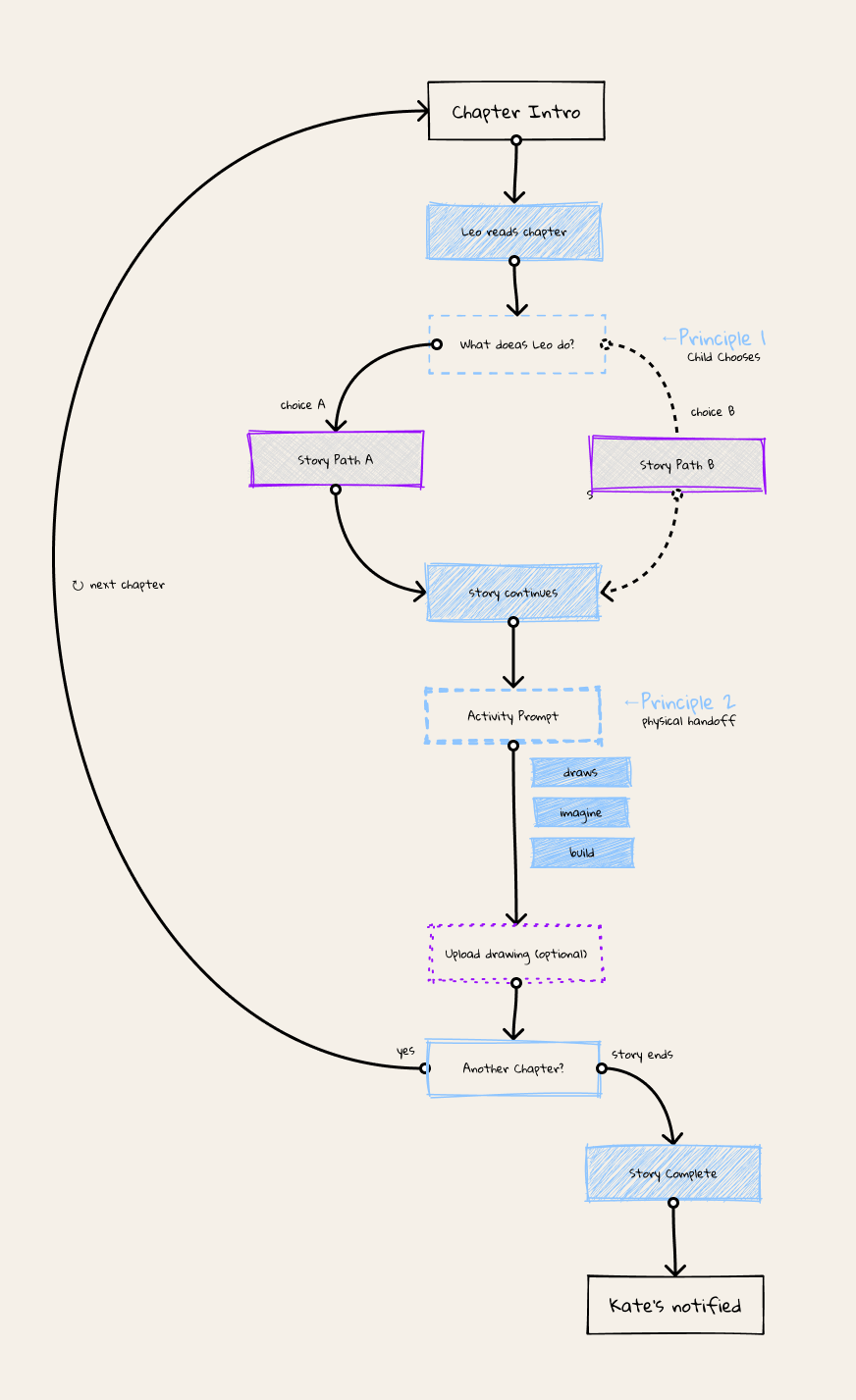
Flows were mapped before any wireframing. The goal was to understand how the parent and child threads intersect, and where the critical moments of handoff occur.
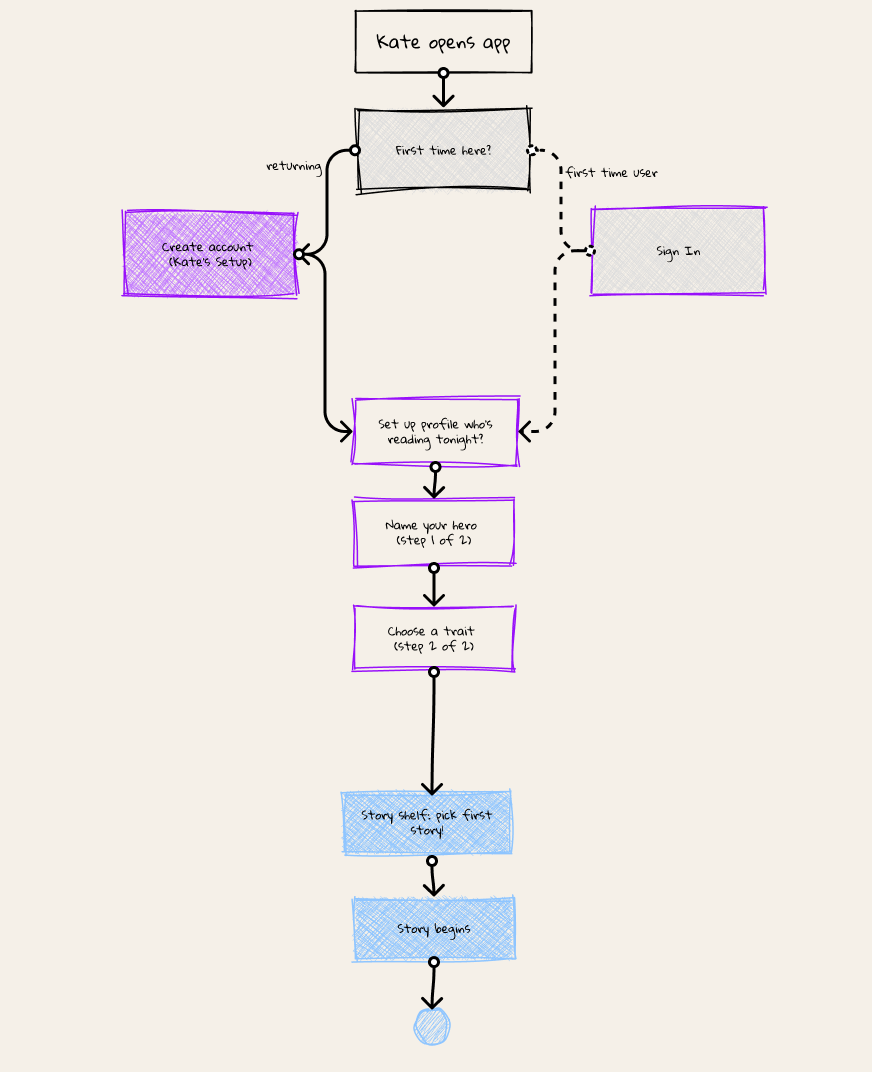

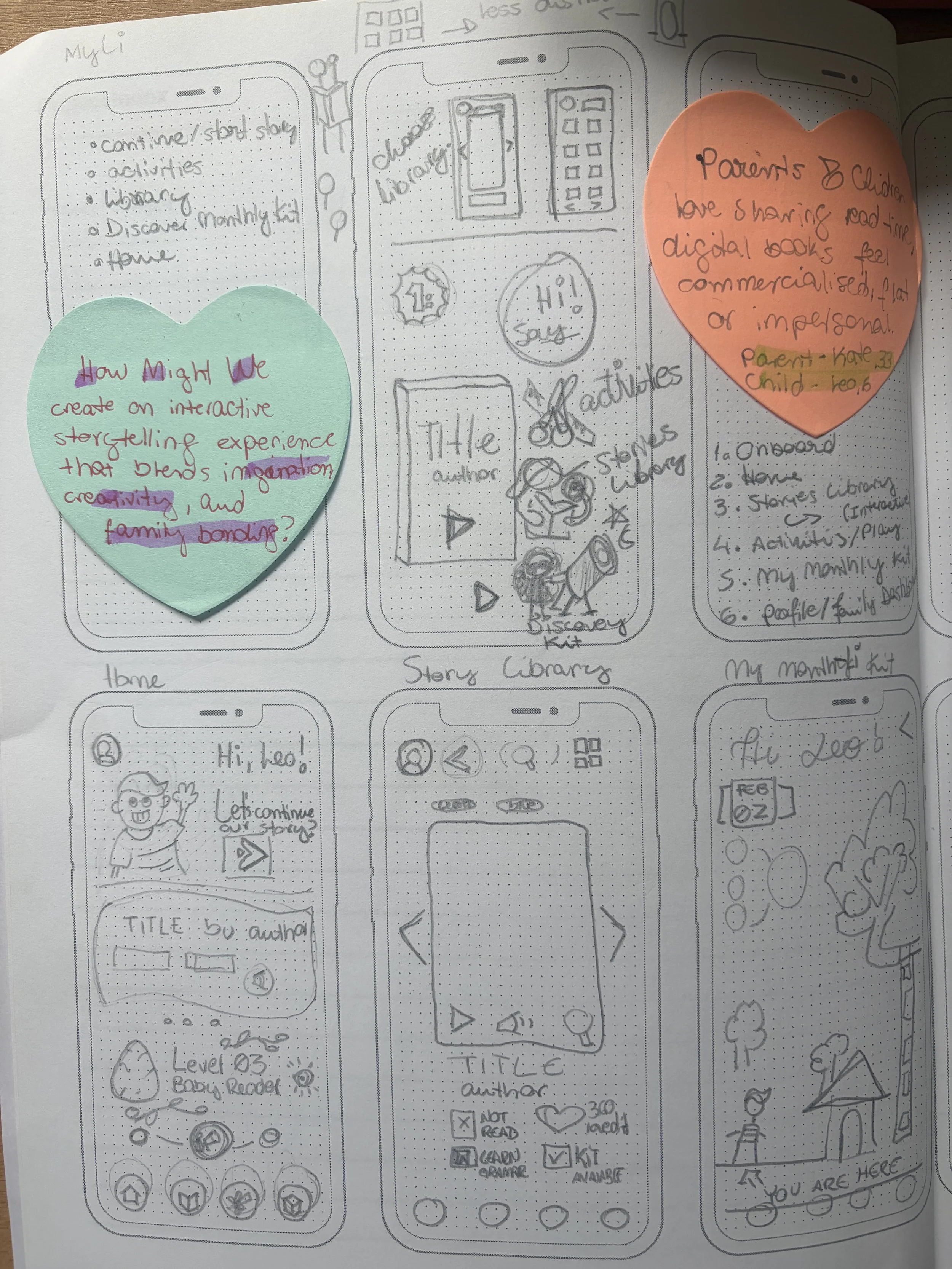
Sketching and experimenting.
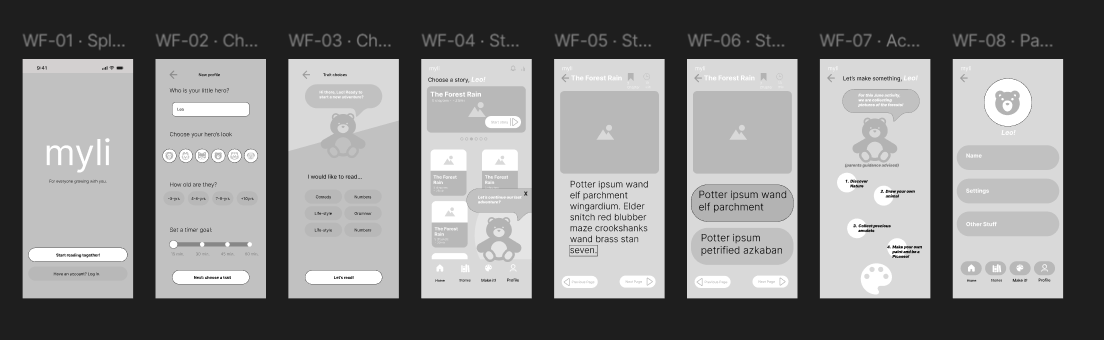
Shot of my low fidelity wireframes, Figma.
Core Flow:
The Reading Experience
From a personalised opening to a choice that changes the story
This is the sequence where the three design principles stop being words on a slide and become five actual screens. Every step was tested against one question: does this give the child something to do, and does it give the parent a reason to stay close by?
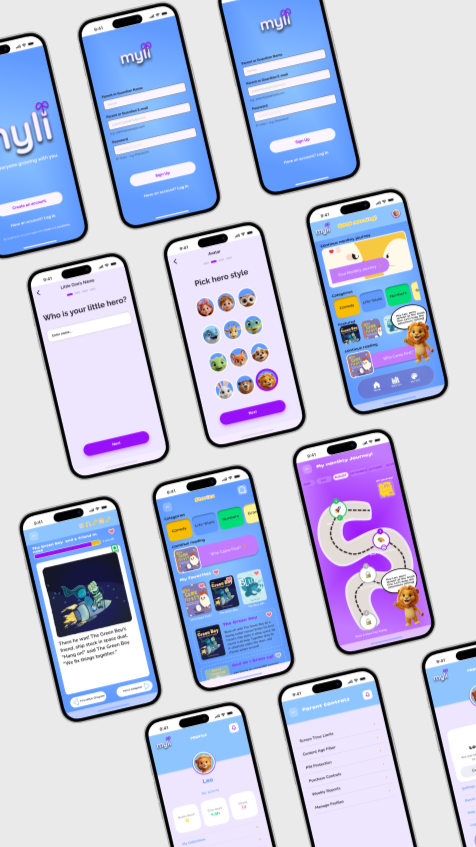
A system to hold attention and trust
-
![]()
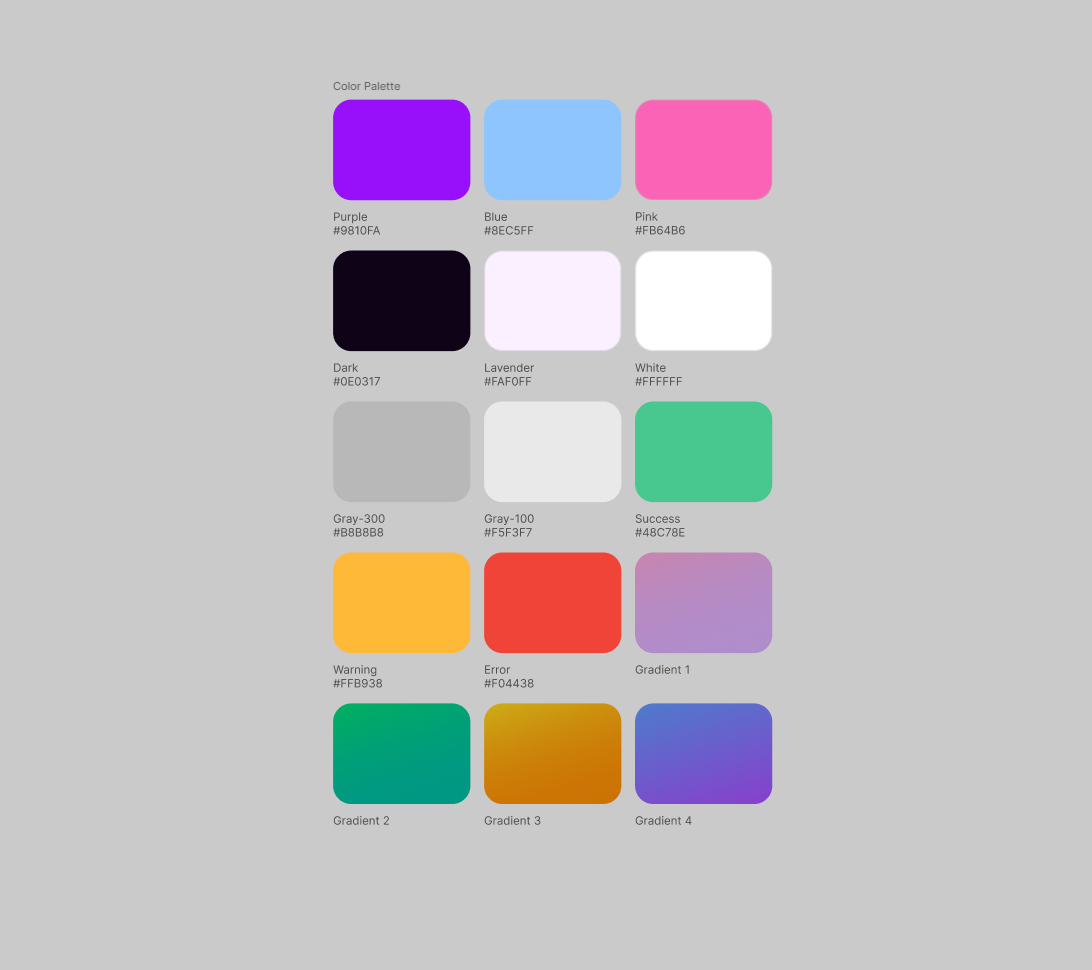
Colour with a job to do
The palette isn't decorative, it's functional. Each colour family (pink, green, gold, blue) carries through from the splash screens into the age chips further down, so a child can recognise "their" colour before they can read their own age group. Gradients keep the warmth of hand-drawn illustration without slowing anything down.
-
![]()
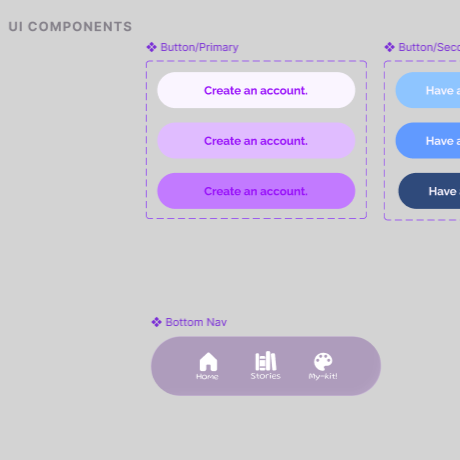
Built for small hands and tired evenings
Buttons, inputs, and navigation were designed around the two moments that matter most: a parent setting up an account in under a minute, and a child never once getting stuck. Every state, default, filled, error, was designed to be forgiving. Nothing here should punish a wrong tap.
-
![]()
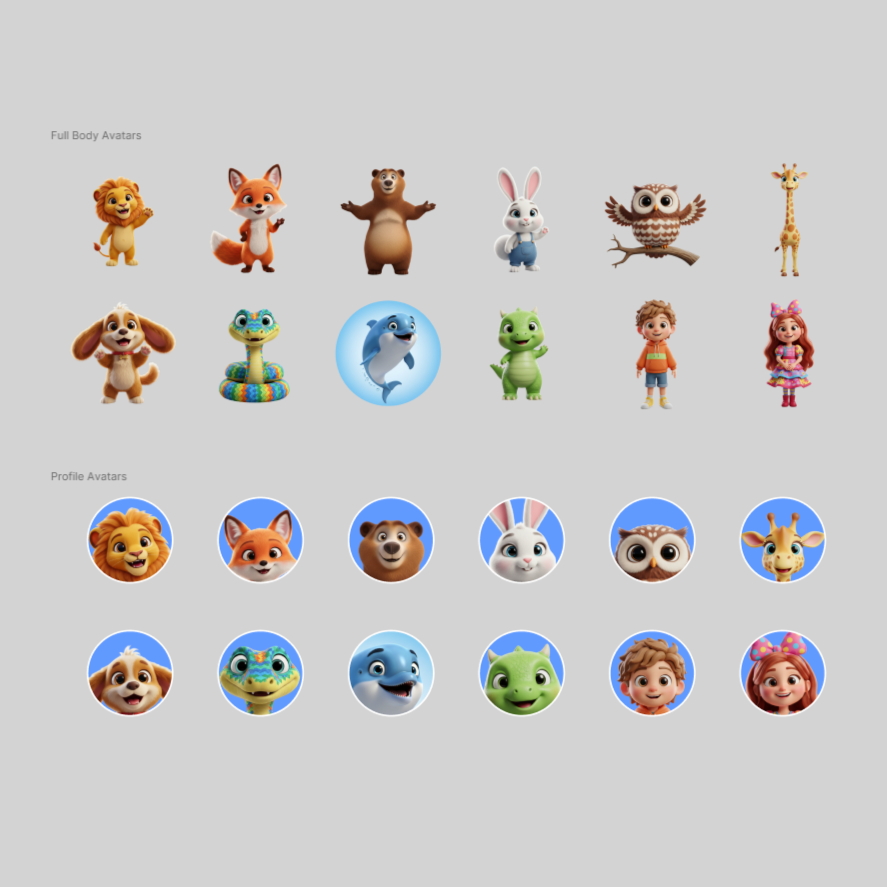
Seeing yourself in the story
Twelve full-body and profile characters give every child a way to picture themselves inside Myli before they've even opened a story. This is personalisation at the account level, not just the content level: the same principle that made my niece sit still for forty minutes once the hero got her name.
-
![]()
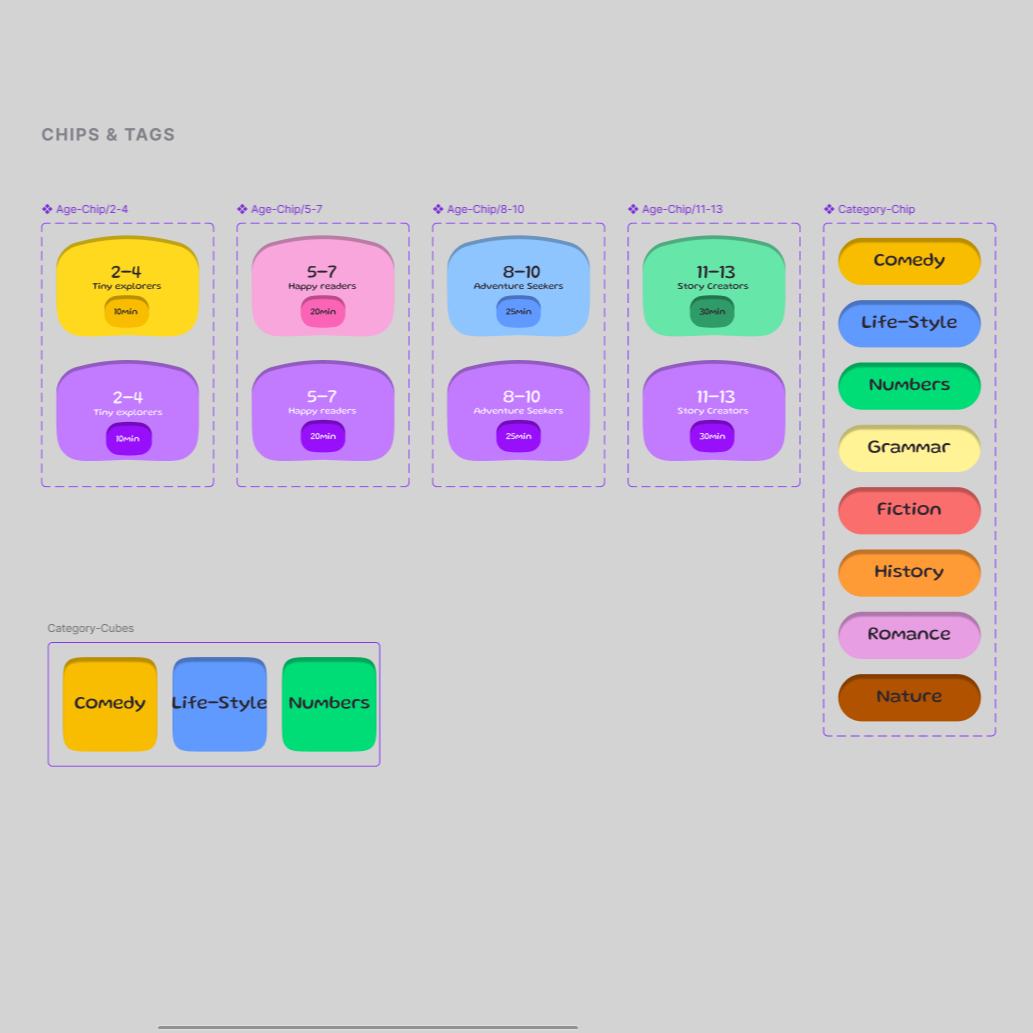
The system doing the research's work
Age chips (2–4, 5–7, 8–10, 11–13) each carry a persona label and an expected reading duration, because a four-year-old and an eleven-year-old were never going to be served by the same screen. Category tags (Comedy, Fiction, History, and more) let a child build their own shelf. Both came directly out of the "age changes everything" insight from research, not from a style guide.
Design System
Myli needed one visual language that could flex across two very different users without becoming two different products. Every token, component, and character below answers one question: does this work for Leo and Kate, at the same time?
A system built to hold a six-year-old's attention and a tired parent's trust
screens
-
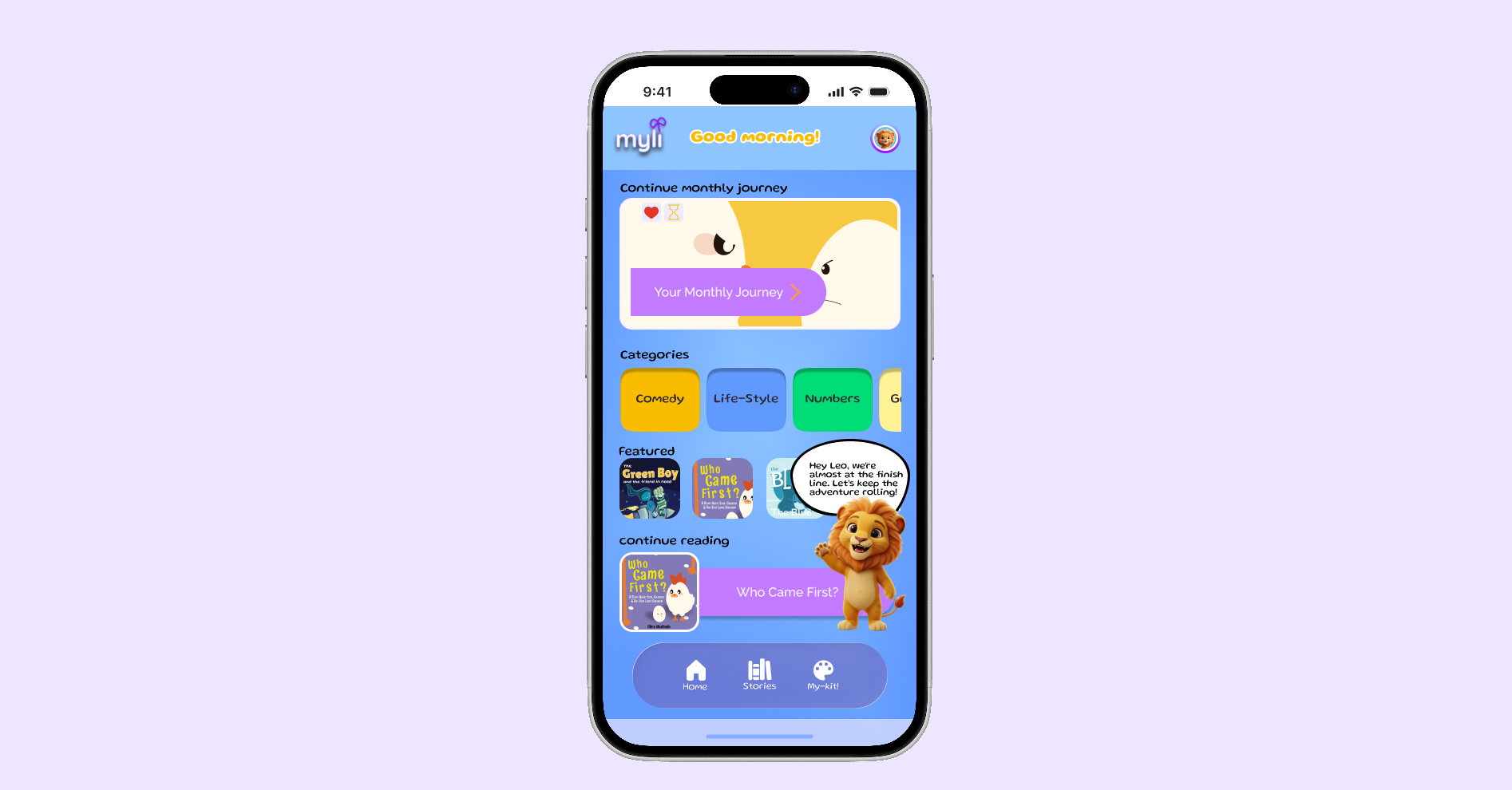
Story Home
Where the day starts
"Good morning!" And straight into where they left off. The Continue Monthly Journey banner and the featured character prompt turn a cold open into a pickup — exactly where Leo left the story, exactly what Kate needs to see in three seconds before she can put her phone down.
-
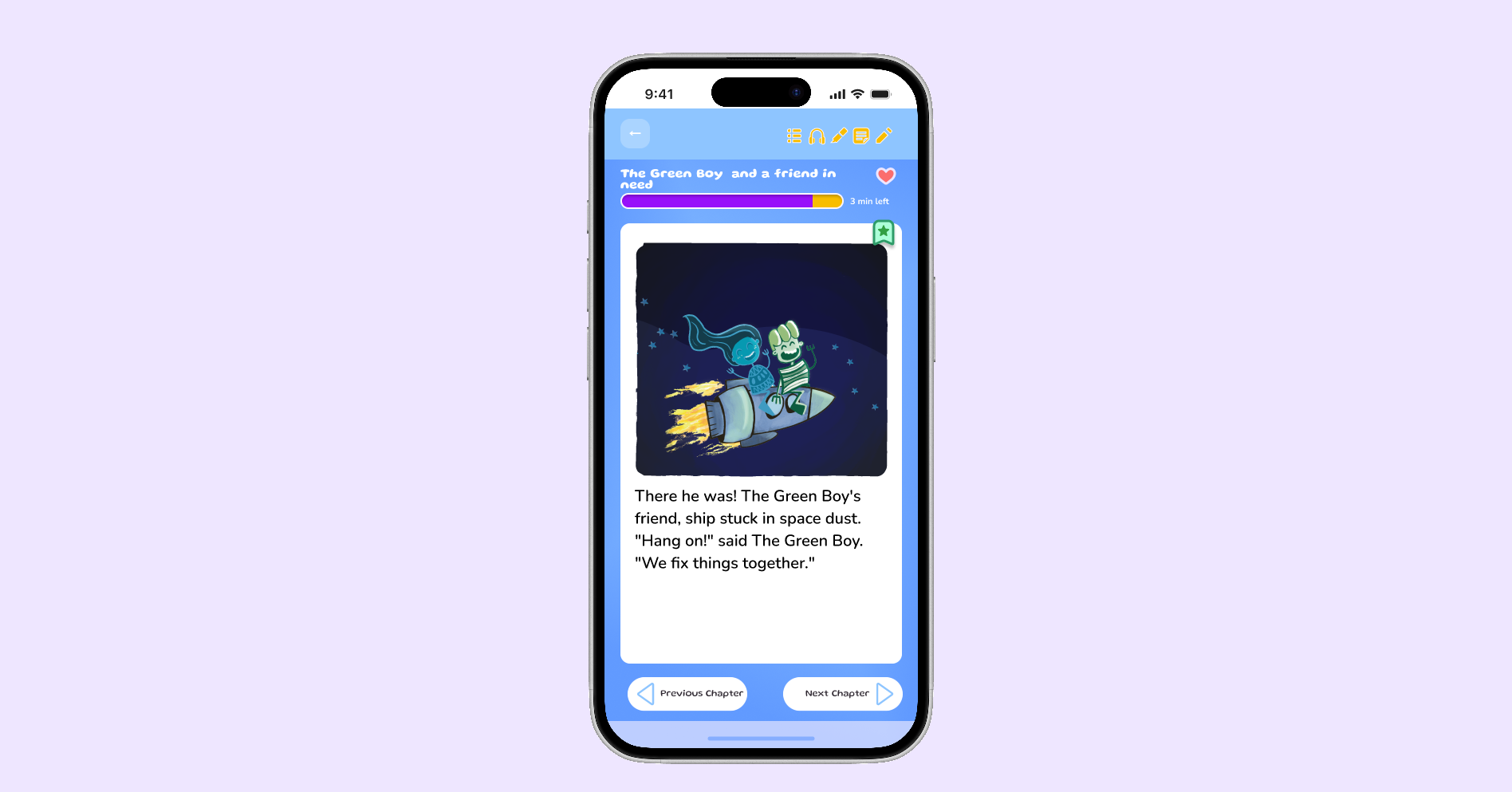
Story Reading
Setting the story, not skipping to the choice
Before Leo can choose anything, he needs a reason to care what happens next. The reading screen carries the narrative, illustration, progress bar, short text, so the choice on the following screen means something instead of being a random fork.
-
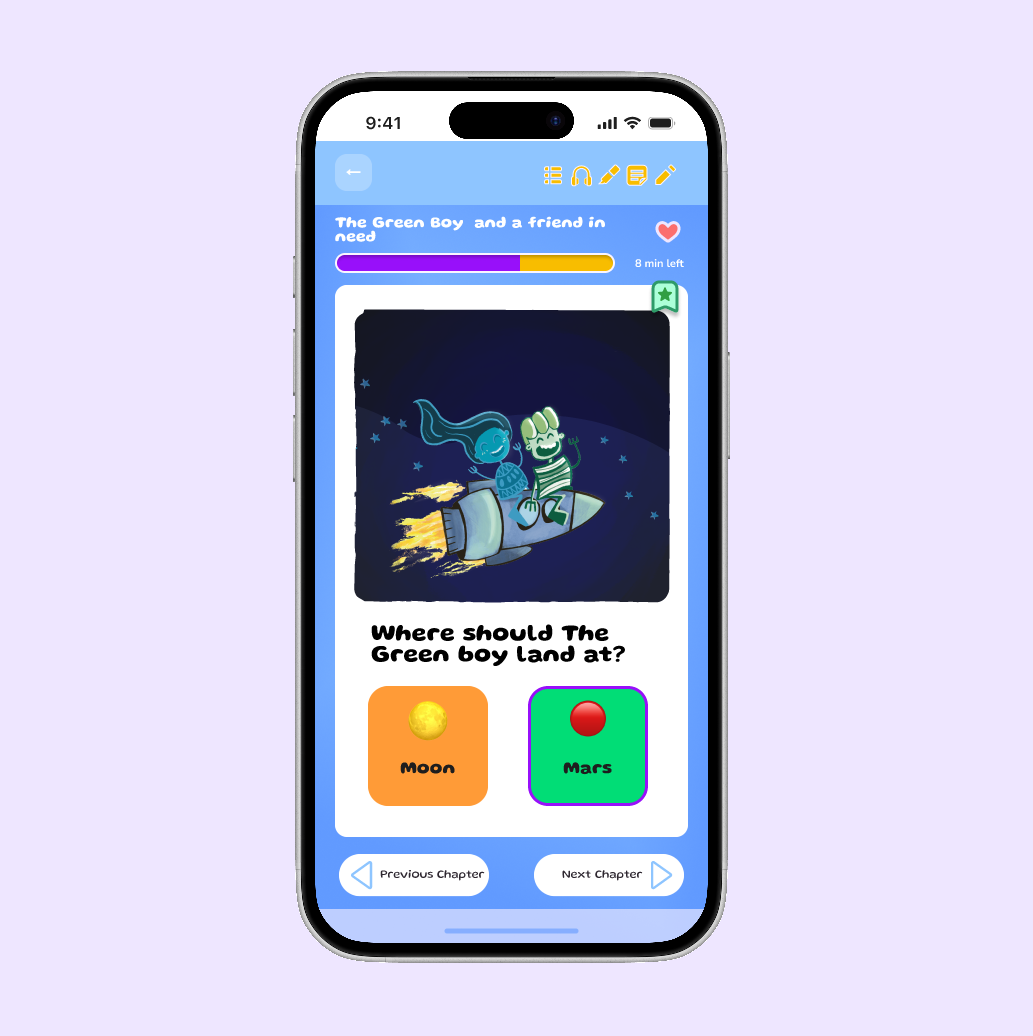
Story Choice
Moon or Mars: the principle, made real
This is "Choice over consumption" as an actual screen. Every observation-only page from the original wireframes was redesigned until it looked like this: two real options, a real consequence for the story, and control handed to the child instead of the app.
-
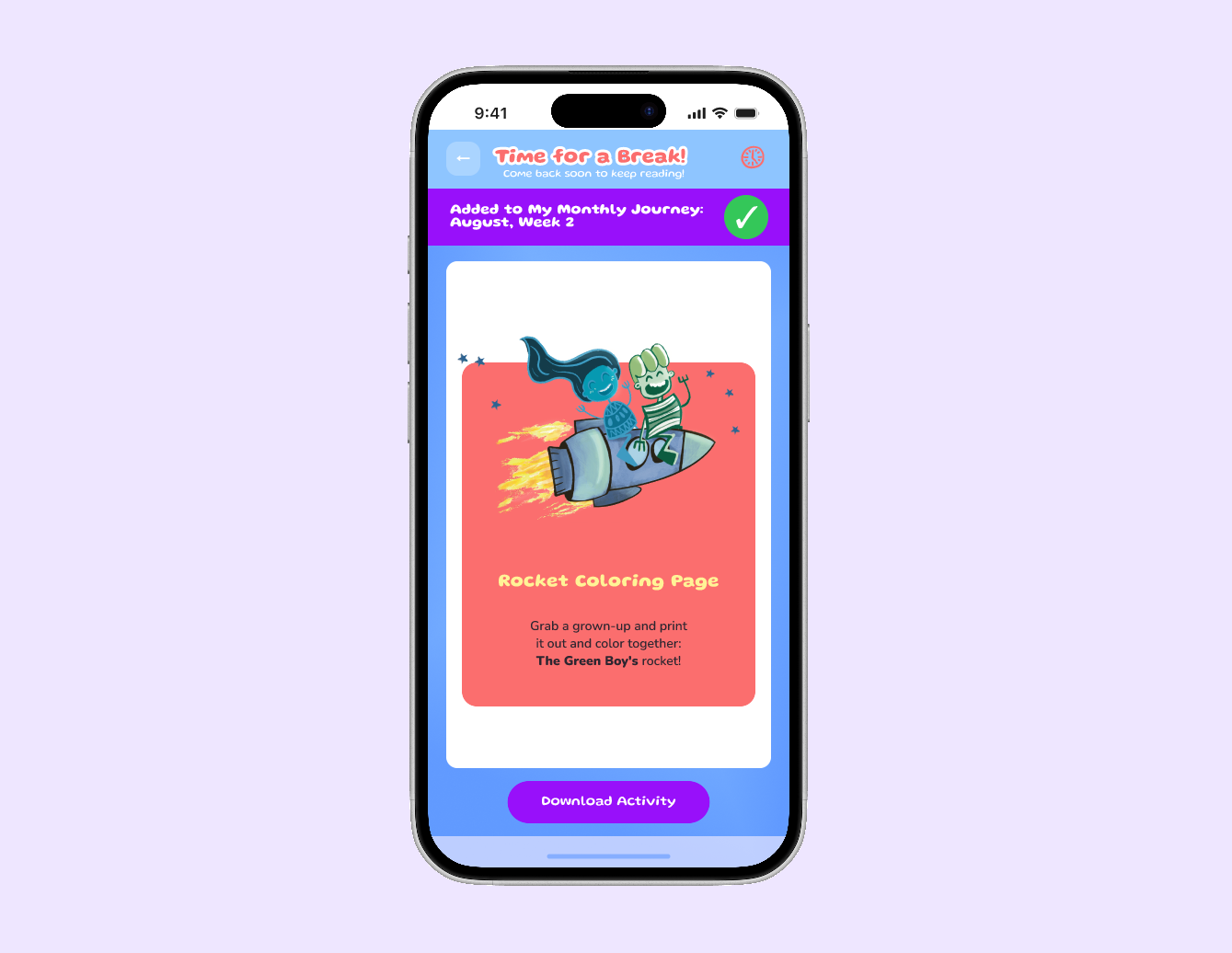
Activity Prompt
Time for a break, on purpose
Here, "stories extend beyond the screen" becomes an instruction, not just a principle: a coloring page tied to the exact chapter Leo just read, a direct line to the grown-up in the room, and a download button that's the moment the story leaves the device. The same instinct that had my niece drawing the next scene at breakfast, just built in instead of left to chance.
-
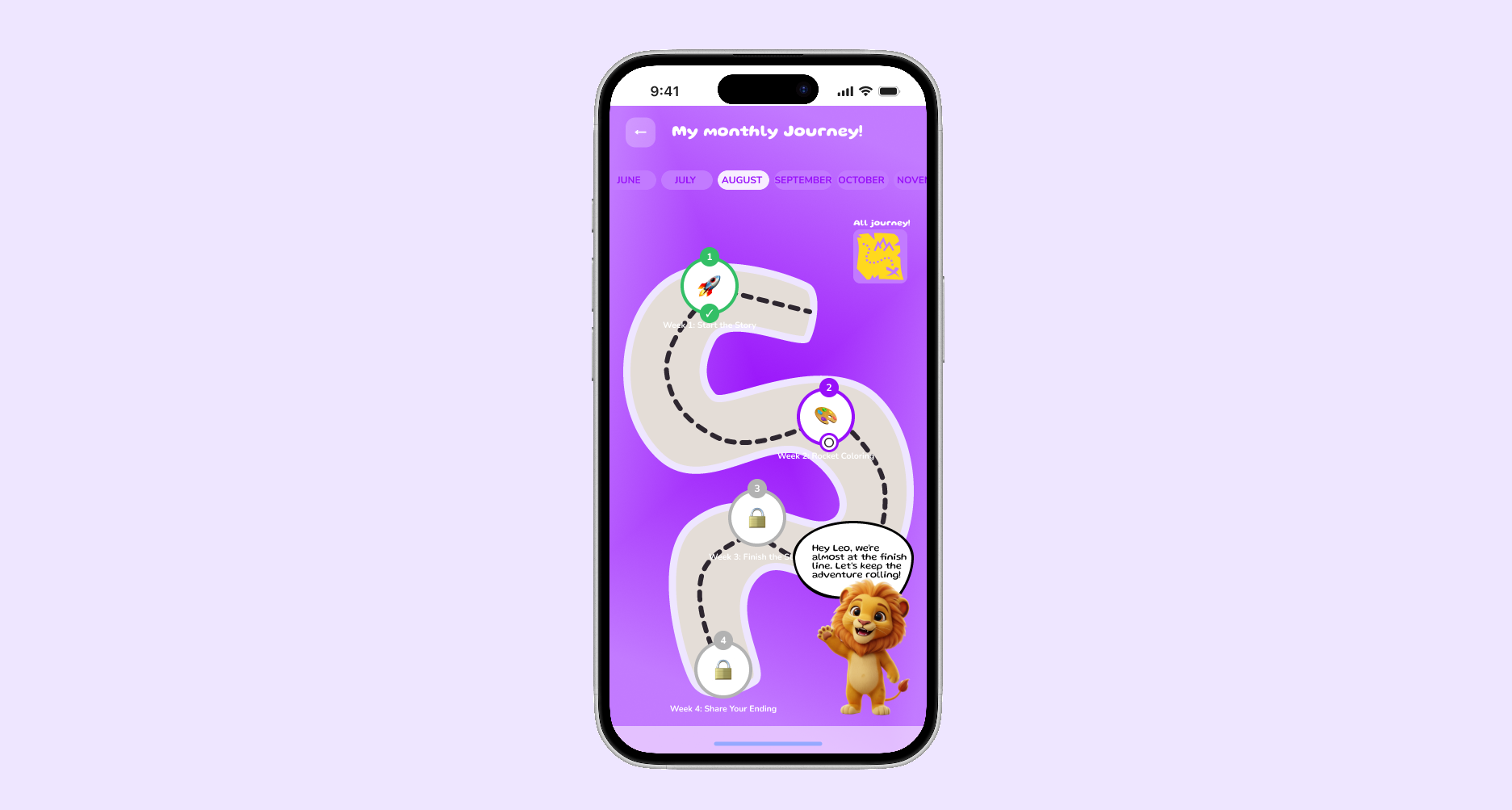
Monthly Journey
Where the offline moments add up
When the chapter ends, the story doesn't. The path-style progress map is where "stories extend beyond the screen" gets literal; each stop is a drawing prompt or a small offline activity, the same instinct that had my niece drawing the next scene at breakfast, just built into the product instead of left to chance.
-
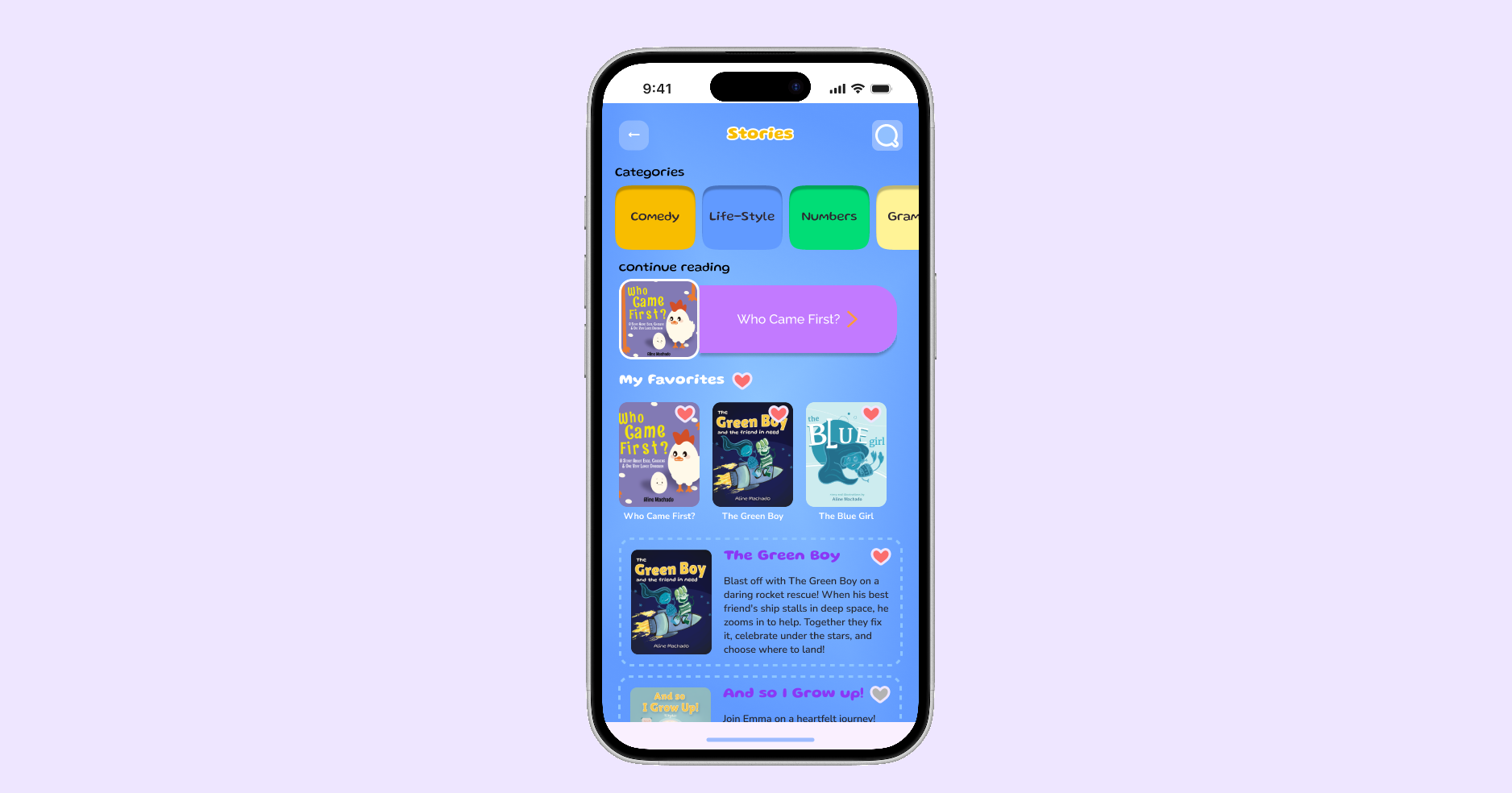
Stories / Library
Coming back is the whole point
Categories, continue reading, and favourites exist so a child can find their way back to a story on their own, and so a parent can see what's been read without asking. This is where "parents participate, not supervise" lives structurally: visibility without oversight.
WHAT I'M UP TOThis is a process. Here's how I'm working right now.
The design system and the core reading flow, the six screens above, are built and documented in Figma. What's left is testing them with real families, building the remaining flows, and getting the whole thing hand-off ready.
Built: system & core flow
The design system, brand, tokens, components, avatars, chips, and the full Reading Experience flow, from Story Home to Monthly Journey, are designed in Figma. Same rigor as everything above: nothing here shipped without a research reason behind it.
Now: testing with real families
Same approach as the research phase, real parents and kids, not assumptions. Right now I'm testing whether Story Choice actually reads as agency to a six-year-old, and whether Kate can set up an account in under a minute like the target says. No precious designs, if something isn't working, it goes.
Next: onboarding, parent layer, and going live
Once the core loop holds up, I'll build out the remaining flows, onboarding, account, parent dashboard, and publish here and across socials. Follow along for updates and the occasional behind-the-scenes moment.
"How do you design one experience that works for a six-year-old and a tired parent at exactly the same time, without simplifying it for one and overwhelming the other?"
The harder question I haven't solved yet